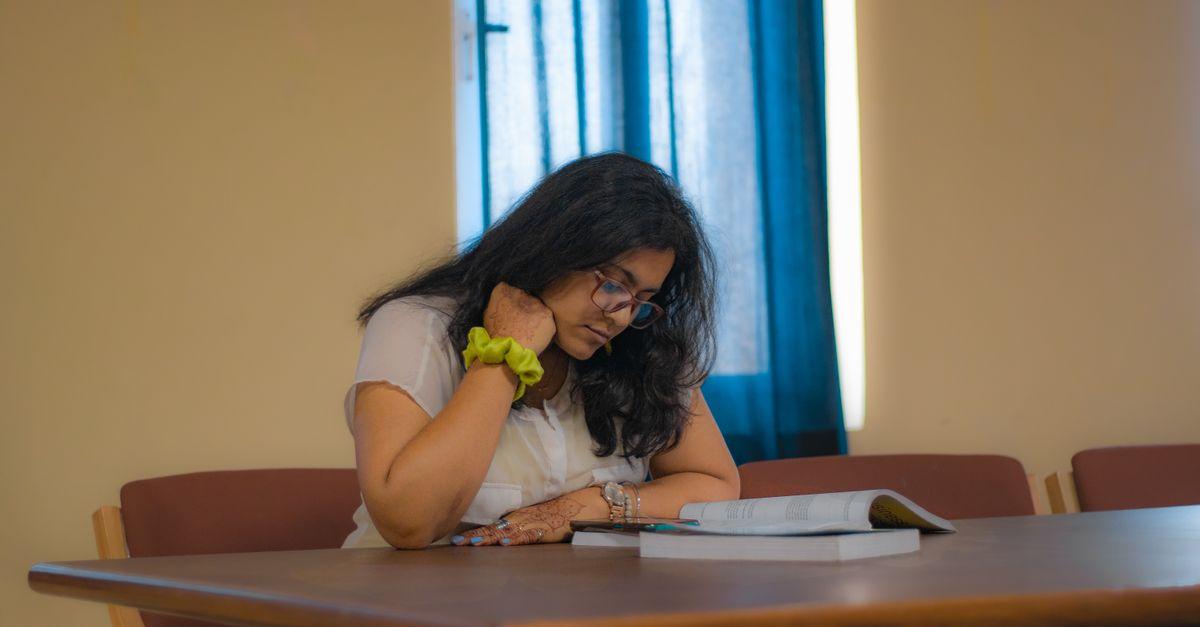
Most candidates prepare for the dMAT in a quiet room of their own choosing. The exam is sat in a shared room with other people, and that room has a soundtrack: keys clicking, chairs scraping, someone coughing two rows back, an invigilator walking the aisle, a candidate standing up to leave before you have reached the halfway mark. None of this is a disruption in the sense the official rules recognise. It is the ordinary texture of a test centre, and nobody will pause anything because of it. If you have never worked through it, it will cost you items on the day, not because the noise is loud but because your attention keeps leaving to check on it. This article is about that background layer: what to expect, how to practise for it, and what to do when your focus slips anyway.
Know what the room will sound like
A computer-based test room is rarely silent. Expect a steady rhythm of typing and mouse clicks, the hum of the machines, and the small movements of a group of adults sitting still for a long time. Expect staff to walk the room, lean in to check a screen, and occasionally speak quietly to someone. Expect candidates to finish at different times. Someone standing up and walking out while you are deep in a hard item is one of the most common sources of a lost minute, because the mind reads it as information about how you are doing. It is not. Finishing early tells you nothing about how well someone did, as our note on finishing a section early explains.
Naming these in advance does most of the work. A sound you expected is a sound you can let pass. A sound you did not expect becomes a question, and questions pull you out of the item. Before test day, walk through the list above once and decide that each item on it is normal.
Stop practising only in silence
If every practice session happens with the door shut and headphones on, you are training a skill that is slightly different from the one the exam needs. Keep most of your sessions quiet, since that is where you learn fastest, but deliberately move a portion of them somewhere with ordinary background activity: a college library's main reading room, a shared living space while others are awake, a quiet corner of a canteen between meals. Do not put music on. The point is unpredictable human noise, not a wall of sound you can tune out.
Make at least one of your timed sittings a noisy one. A full run of the free dMAT practice test in a shared room will show you exactly which sounds pull your attention and how long it takes you to return. That is far more useful to learn in practice than in the exam. Our guide to simulating exam conditions covers the rest of the rehearsal; treat the sound of the room as one more condition to match.
While you practise in noise, watch for a particular habit: looking up. Each glance at the source of a sound is a small exit from the item and a re-entry afterwards, and the re-entry is where the time goes. Train yourself to notice the sound without turning your head. The screen in front of you is the only thing in the room that can earn you marks.
Come back to the item, not to the room
On the day, your attention will still drift sometimes, and the goal is not to prevent that but to shorten the trip back. The most reliable way back is specific: reread the question stem, not the whole passage, and then take one concrete step on the item. Write one line of rough work, eliminate one option, read the next sentence. Starting a small action brings your attention with it in a way that telling yourself to concentrate never does.
Avoid the two detours that feel like coping and are not. The first is the review detour, where a noise breaks your focus and you respond by scrolling back to check an earlier answer. That trades one lost thread for two. Our note on changing answers sets out the only good reason to revisit an item, and "I got distracted" is not on the list. The second is the clock detour, where every interruption triggers a check of the remaining time. Time checks are useful at planned points, as our article on keeping time without a watch describes, and corrosive when they become a reflex.
If the pull is strong, use the short reset you have already rehearsed for nerves: hands off the mouse, a slow breath or two, eyes on the question stem, then the next concrete step. The routine from our guide to managing test-day anxiety works for distraction just as well, because the mechanism is the same. You are giving your attention somewhere definite to land.
The distractions you bring in yourself
Not every interruption comes from the room. The item you were unsure about three questions ago, the plan for the evening, the thought that the person next to you seems faster: these are internal, and they are harder to escape because you cannot look away from them. The approach is the same as for external noise. Notice the thought, do not argue with it, and return to a concrete step on the current item. If a particular worry keeps recurring in practice, write it in your error log after the sitting as a cause, in the same way you would record a misread figure. Patterns in your attention are as fixable as patterns in your arithmetic.
When it stops being background
Background noise is yours to manage. A problem that persists is not. A neighbour who is unwell and getting worse, a conversation outside the room that does not end, a machine making a sound that makes the room unworkable: these cross the line from texture into disruption, and the right response is to tell the invigilator while it is happening rather than endure it and mention it on the way out. Our article on test-day disruptions covers that side in full.
One practical point sits between the two. If you think you would want ear protection, do not assume it is allowed. The official rules restrict what may be on the desk and what counts as an aid, so check the current terms and, if they are unclear, ask the test centre before the day rather than at the door.
Make the room ordinary before you arrive
You cannot choose how quiet your test room will be. You can choose whether its sounds arrive as surprises or as things you have already heard and decided to let pass. A few sessions in ordinary noise, one timed sitting in a shared space, and a rehearsed way back to the item will cover almost everything the room can throw at you. Walk in expecting the clicks, the footsteps and the early leaver, and they will have very little to take from you.